Silent teachers, lasting lessons: Heidelberg honors the generosity of body donors
For the students who study human anatomy at Heidelberg, some of their most influential teachers never speak a word. Yet their lessons are among the most profound – shaping not only how students understand the human body, but how they will care for others throughout their careers.
That spirit of gratitude and reflection filled Herbster Chapel during Heidelberg’s annual Body Donor Appreciation Ceremony, a longstanding tradition led by students in the Prosection (BIO 403) class. Now in its 14th year, the ceremony honors the individuals who have generously donated their bodies to medical education and the families whose extraordinary gifts make this unique learning experience possible.
In his welcome, Cody Thomas spoke for his classmates when he described the three cadavers currently housed in Heidelberg’s Barlow Body Donor Lab as “our first true teachers in the study of anatomy and the complexity of the human body.”
During her invocation, Jillian Ditmer reminded those gathered of the humanity behind each gift. “We hold them in our hearts with profound reverence,” she said, recognizing each donor’s decision as a “final act of extraordinary generosity and courage.”
The ceremony was more than an expression of thanks. It was a celebration of the lives and legacies of these “silent teachers” – individuals whose generosity allows students to learn with compassion, practice with dignity, and carry those lessons into the future.
Built on generosity
President Rob Huntington offered reflections on the history and significance of Heidelberg’s body donor program, now in its 39th year.
Since the Prosection course first began incorporating human cadavers in 1988, Heidelberg has welcomed 25 body donors. The program began with one donor, expanded to two in 2005 and grew to three in 2016. The donors rotate each year, providing successive generations of students with an extraordinary opportunity for hands-on anatomical study.
Rob credited the late Dr. George Barlow, a Heidelberg biology professor who helped generate early support for the program, and Dr. Pam Faber, who joined Heidelberg’s faculty in 1987 and established the program in partnership with The Ohio State University’s Department of Anatomy. Pam, who recently retired, created the Barlow Body Donor Lab and taught the Prosection course for nearly decades.
The program also reflects a long history of support from Heidelberg friends and alumni. Then-Interim President Dr. Jim Getz ’58 helped connect the University with local manufacturer Webster Industries for early support, while alumnus Dr. Chris Longaker ’64 provided early financial backing. The most significant investment came from alumna and Trustee Dr. Susan Wolf ’71, whose generosity endowed the program. Additional donors have helped provide specialized equipment, including the lab’s downward-drafting tables.
Rob called the Prosection experience one of Heidelberg’s most distinctive educational opportunities. “I believe this course is on a very, very short list of the most distinctive, dynamic, and differentiating learning opportunities we offer at our school. It really stands out,” he said.
But, he emphasized, the program's significance goes far beyond the equipment, facilities or curriculum.
“This is all about respect and gratitude. These are selfless acts the donors and their families make … for the benefit of our students. Their ultimate gift underscores how precious life is.”
He added that Heidelberg considers it a privilege to care for and steward the donors’ gifts.
Lessons beyond the lab
Dr. Morgan Kocher, who is teaching the Prosection course for the first time this year following Pam’s retirement, shared a faculty perspective on the experience. Having studied with cadavers as an undergraduate himself, Kocher understands firsthand the difference this kind of learning can make as students transition from college into professional programs and careers.
Working with actual human bodies deepens students’ knowledge and appreciation of anatomy in ways that textbooks, diagrams and lectures cannot replicate. Just as importantly, it reinforces the responsibility that comes with learning from another person's final gift.
Morgan said he and his students remain very cognizant of “how much the families give up for us to have this opportunity.”
For Olivia Raubenolt, who will begin medical studies this fall at Lake Erie College of Osteopathic Medicine, that opportunity has been transformative. She spoke about moving beyond textbooks and diagrams into the direct anatomical reality of the human body, while recognizing the lives and stories behind every donation.
It is important, she said, to honor the individuals whose generosity makes that experience possible.
“The donors become a meaningful part of our stories,” Olivia said. “Thank you for a gift that will continue to make a difference long after our time at Heidelberg comes to an end.”
Classmate McKenzie Wohlford noted that Heidelberg’s body donor lab – a rare resource among small private undergraduate institutions – was one of the factors that influenced her decision to attend Heidelberg.
Throughout their studies, students often find themselves thinking about who the donors were and the lives they lived. The foundation they provide, McKenzie reflected, has helped shape students into who they are and who they will become.
Dylan Thomas, who graduated in May 2026 and is completing his MBA, will continue his education at the University of Pittsburgh's Doctor of Physical Therapy program next year. He described the cadaver lab as an experience that could never be duplicated through traditional classroom instruction.
The most valuable lesson, he said, was recognizing that “behind every structure we study is a real person.”
Long-lasting impact
Video testimonials from Heidelberg alumni now pursuing advanced degrees offered a powerful reminder of the program's lasting impact.
Kacy Connolly ’26, now a medical student at LECOM, described the experience as her first step in learning to value her future patients. “I will be forever grateful for the experience,” she said.
Caitlyn Cross ’26, now attending The Ohio State University College of Veterinary Medicine, credited the lab with helping her develop confidence and comfort with anatomical study before entering veterinary school. She also emphasized the generosity of the donors and their families. “Your generosity made a lasting impact on my education and helped prepare me for my future career,” she said.
Carson Colohan ’25, a second-year student at Case Western Reserve University School of Dental Medicine, reflected on the academic preparation and lifelong relationships he gained at Heidelberg. The study skills he developed in the lab helped him approach the demands of graduate school with confidence. His most memorable observation captured the profound connection between learning and the people who make it possible:
“In total silence, they were our first patients.”
A legacy carried forward
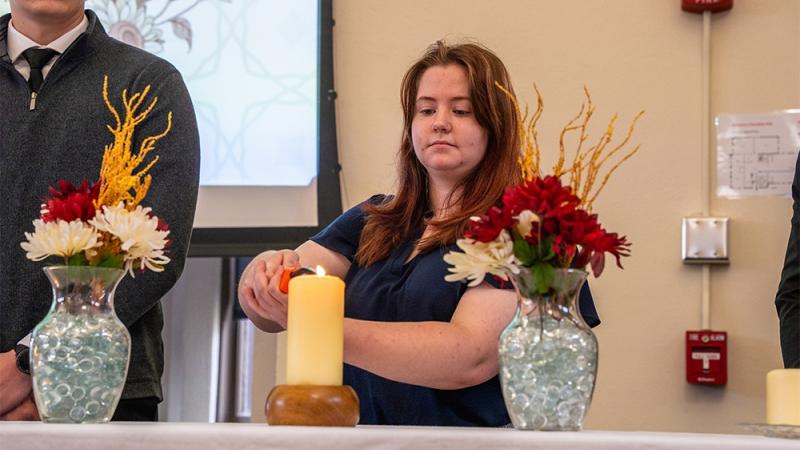
The ceremony also included a candle-lighting tribute, with three candles representing the donors' personal lives and stories, gratitude for the knowledge and lessons they shared, and recognition of the enduring legacy they leave in students' hands and careers.
Students enrolled in BIO 363 and 364, the Anatomy and Physiology I and II courses required before advancing to Prosection, also participated. Representing her class, Livia Blackburn shared reflections about what she learned and the significance of the donors' contributions to her education.
Mikael Paulson brought the ceremony back to the gratitude that connected everyone in the chapel.
“We may never know their names, but their lessons are permanently etched in our minds and hands,” he said. “Their gift has taught us more than anatomy. They have taught us humility.”
November 13, 2026