
Constitution in action: Judge brings court to campus
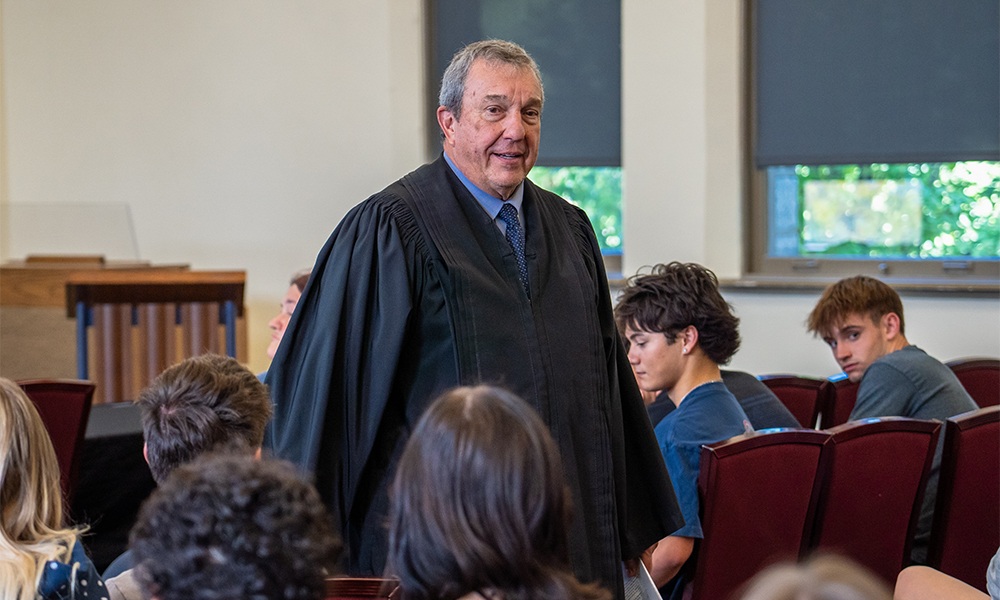
Students who attended Heidelberg’s annual Court on Campus might have wondered if they were in a classroom rather than a courtroom.
A belated observance of Constitution Day, Common Pleas Judge Steve Shuff – a ’75 Heidelberg grad – brought his courtroom a few blocks down Market Street to conduct a day of criminal hearings on campus on Tuesday. Court on Campus gives ’Berg students the opportunity to witness the Constitution in action.
The day consisted of a variety of legal hearings just as they would have taken place at the Seneca County Courthouse. The Constitution was ever-present in each hearing – and in between.
During breaks, Judge Shuff stepped out from behind his makeshift bench in Herbster Chapel to quiz the students about their knowledge of the Constitution.
“The Constitution should be our foundation, our rock, our floor,” Judge Shuff said. “I don’t know if the Constitution should be amended so often.”
In response to a question from a student, the judge conceded that the amendment process is one of his greatest frustrations with the U.S. Constitution as well as individual state Constitutions.
He also discussed the Bill of Rights with students. “How many of the 10 Bill of Rights do I see daily as a judge?” he queried them. “I see seven of the 10 every day and I’m so happy I do.
“They are not a burden. It’s a blessing to have these rights in our Constitution, especially the right to a jury trial,” he said.
Dealing with substance abuse
Rarely a day passes that Judge Shuff isn’t confronted with defendants dealing with substance abuse issues. Students witnessing the hearings on Tuesday got to see that first-hand.
Judge Shuff granted intervention – a substance abuse treatment and recovery program called PIVOT – in lieu of conviction for one defendant who pleaded guilty to possession of cocaine.
“You’re getting a great deal,” he told the defendant. “You do the intervention program, and you do it well, and the guilty plea goes away.”
PIVOT is a court-supervised program that stands for Participating in Victory of Transition. It connects offenders with treatment, life services, and resources, giving them the tools to get on the right track to long-term sobriety.
By agreeing to enter the PIVOT program, defendants give up a series of their Constitutional rights such as a jury trial, cross-examining witnesses, subpoenaing witnesses, testifying on their own behalf, and others. The judge’s explanation aligned perfectly with the theme of Court on Campus.
The final case of the day also related to PIVOT, and this one had a tearful, happy ending. The defendant, a young woman, had petitioned the court to have her record expunged.
She successfully completed all the requirements of PIVOT and literally turned her life around – a true PIVOT success story.
Since her conviction on drug charges over three years ago, “The way I live my life has changed,” she told Judge Shuff. “PIVOT helped me see things differently. I’m a better mom, a better employee, a better community member.”
He granted her request, getting choked up as he told her, “You have been remarkable. Congratulations.”
Then, he came out from behind his bench for an emotional embrace with the woman.
The students applauded. Through tears, she acknowledged them and departed the courtroom, her case sealed and all her Constitutional rights and privileges restored.
A welcome, joyful ending to the day.
October 15, 2026