Honors research brings senior Education major into a real-world classroom
For Heidelberg senior Ainsley Manger, Honors research became more than an academic requirement. It became an opportunity to experience the impact of the classroom environment firsthand.
Ainsley, an Early Education major who will graduate in May, centered her Honors project on “The Importance and Effects of the Physical Classroom Environment on Students and Their Learning.” Her research focused on how learning spaces influence students beyond academics, shaping their social, emotional, and physical development.
“As a future educator, I want to be able to support the whole child,” Ainsley said. “That means supporting not only the academic needs of students, but also their social, emotional, and physical needs. To do that, it’s important to consider all of the environmental factors that affect students, especially the physical environment.”
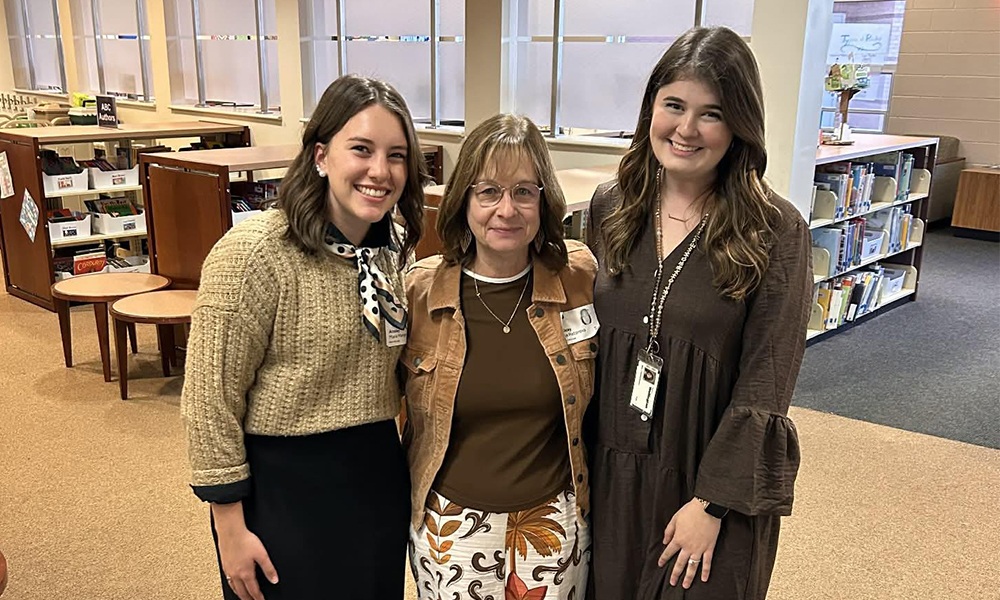
That research soon led beyond campus. With support from her advisor, Dr. Stacey Pistorova, associate professor of elementary education, Ainsley connected with Heidelberg alumna Tori (Hossenlopp) Charbonneau '18, who welcomed her into her classroom at the Wellington School in Upper Arlington.
“Thanks to Dr. Pistorova and Tori’s willingness, we were able to meet and observe her classroom,” Ainsley said. “I was excited not only to see a positive physical classroom environment, but also to see how the children interact with and are affected by the environment.”
From the moment she arrived, the experience stood out.
“The visit was great and something I’ll remember,” Ainsley said. “The people and the school environment were so welcoming.”
What left the biggest impression was how intentionally Tori’s classroom had been created. Rather than designing the space alone, Tori built the classroom alongside her students.
“From bare walls in August to a room overflowing with students’ interests, identities, and work, the classroom told their story,” Ainsley said. “Student self-portraits were hung, photos of families were included, and student work was showcased throughout the space.”
Rather than pulling ideas from a catalog, the classroom reflected the students themselves.
“Students’ identities were evident and valued,” Ainsley said. “Tori included her students, their interests, and who they are in the creation of their classroom.”
Seeing the research come to life strengthened Ainsley’s understanding of her project.
“Seeing Tori’s classroom solidified the data I found and brought the research to life,” she said. “It helped me understand how to implement what I’ve learned and inspired how I want to create my own classroom in the future.”
One lesson stood out most.
“The importance of making students feel valued and seen in the environment where they learn is something I’ll carry with me,” Ainsley said. “I hope to co-create my own classroom with my future students.”
As graduation approaches, the visit also offered reassurance.
“As a senior, becoming an educator can feel intimidating,” Ainsley said. “Seeing a Heidelberg alum apply what she learned here made me feel empowered and more confident in my own path.”
For Ainsley, the experience reflects the kind of support Heidelberg provides its students.
“This experience shows the care and consideration professors have for their students and the alumni connections Heidelberg offers,” she said. “I’m incredibly grateful for Dr. Pistorova’s support, Tori’s kindness, and the opportunities I’ve been given.”
— by Kaidan Mathias, MBA ’26
January 27, 2026