‘Professor’s professor’ lectures on genetics & data-driven storytelling
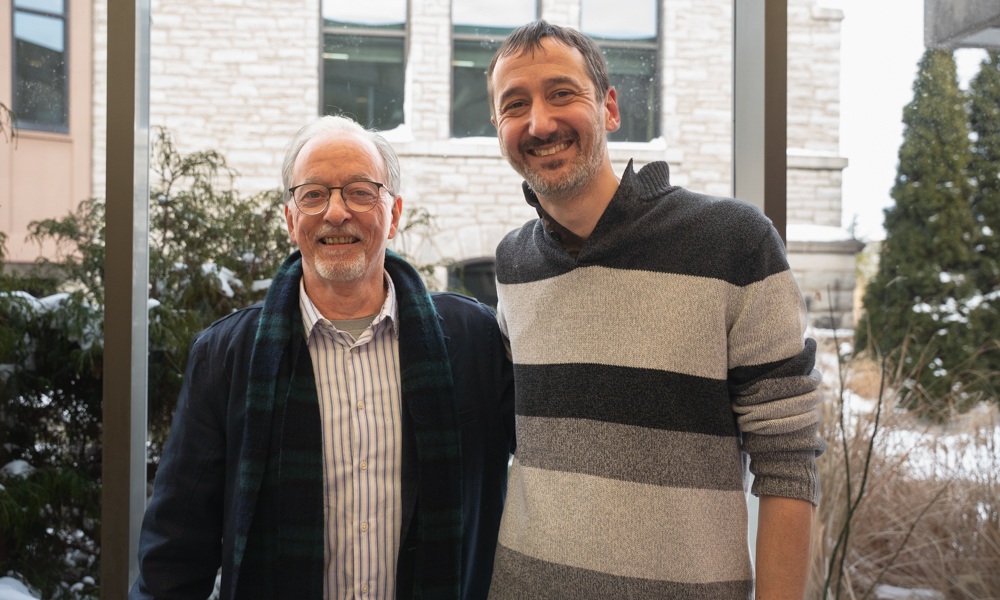
Dr. Tom Freeland, retired Professor of Biology at Walsh University, recently returned to the classroom as a guest lecturer for Heidelberg University students, sharing both his passion for genetics research and his distinctive, discussion-driven teaching style. A specialist in genetics and pharmacology, Freeland holds a bachelor’s degree in biology from West Liberty University and a master’s degree and Ph.D. from West Virginia University. He retired from Walsh University last fall and has since embraced a new chapter as a “self-employed musician.”
The visit also carried personal significance. Heidelberg professors Dr. Nate Beres, Dean of Strategic Academic Operations and Professor of Chemistry, and Dr. Justin Pruneski, Associate Professor of Biology and Environmental Science, are both former students of Freeland. He spoke fondly of their academic journeys and professional success, noting that they were among his top students and that it has been especially rewarding to see them now mentoring students of their own.
A classroom built on curiosity
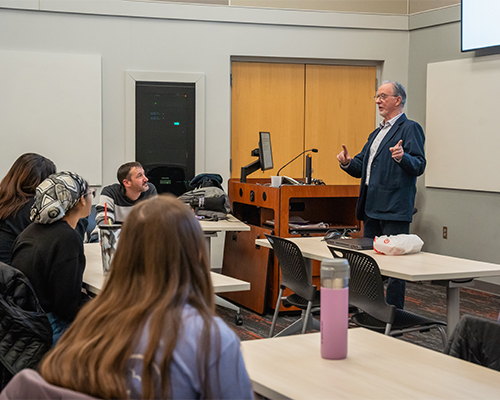
Known for an energetic and interactive teaching approach, Freeland encourages students to speak up, even if it means interrupting.
“Science is no place for politeness,” he told students. “Questions are better than no questions.”
That philosophy has shaped his career in education. Although trained in pharmacology, Freeland discovered his love for teaching when he first took on an adjunct role, an opportunity that ultimately defined his career. Working closely with students in research settings quickly became the most fulfilling part of his work.
Much of his research alongside students has focused on disease, addiction, and neurodivergence, areas where collaboration and curiosity often lead to unexpected insights.
Turning data into discovery
Freeland’s lecture focused on data storytelling through a sequence-to-structure-to-function-to-phenotype approach, a framework that helps researchers transform raw genetic data into meaningful, real-world applications.
He highlighted the growing importance of shared global databases such as GenBank, emphasizing how global participation in data sharing continues to expand research opportunities for institutions of all sizes. For students at smaller schools, these resources create opportunities to engage in impactful research without the need for large laboratories or extensive funding.
“We try to be data storytellers,” Freeland explained, describing the process of taking raw genetic sequences and turning them into information that can inform medical understanding and treatment.
Freeland also discussed how advances in technology have significantly improved the efficiency and scope of genetic research. He pointed to modern analytical tools and computational resources that provide students with the opportunity to process large datasets, identify gene variations more quickly, and explore questions that were once out of reach.
Rather than duplicating existing research, he encouraged students to explore specific diseases or conditions that interest them, identify under-researched genes, and focus their efforts there. This targeted approach allows students to contribute meaningfully to larger research initiatives while building valuable technical and analytical skills.
Beyond biology
The applications of this type of genetic research extend beyond the life sciences. During the lecture, Sean Joyce, Associate Professor of Computer Science and Chair of the School of Natural Sciences and Nursing, noted parallels between genetic analysis and computer science, particularly in areas such as string processing.
The discussion highlighted the increasingly interdisciplinary nature of modern research and how advances in technology create opportunities for collaboration across academic disciplines.
For students in attendance, Freeland’s visit offered more than a lesson in genetics. It served as a reminder that impactful research is driven by curiosity, collaboration, and a willingness to ask questions.
For Freeland, stepping back into the classroom, even in retirement, reaffirmed what first drew him to teaching in the first place: learning alongside students and helping them discover where their questions might lead.
February 4, 2026