Where reef, rainforest meet: Students dive into Belize
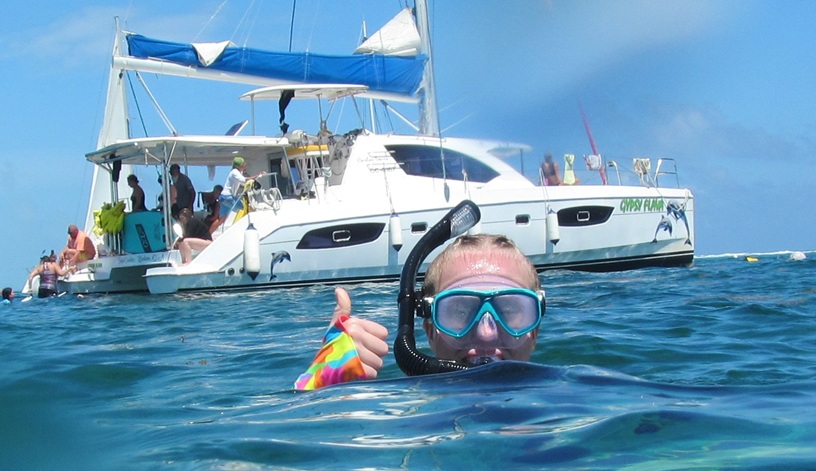
Four Heidelberg students are spending their spring break exploring the natural wonders of San Pedro, Belize, alongside their professor, Dr. Amy Berger, and two Heidelberg supporters. The week-long trip is the centerpiece of the course Caribbean Biogeography, offering students an immersive opportunity to study the Northern Hemisphere’s largest barrier reef system while also experiencing Belize’s diverse coastal and jungle ecosystems. Follow along as the students share highlights from their journey—in their own words.
DAY ONE (March 11)
by Cecelia Groth, junior Environmental and Watershed Science and English Writing major
Most of today was spent on various flights to get from Ohio to San Pedro. I hadn't been on a flight since I was a child, so it was all new to me! The last flight was by far the most interesting, as it was a small flight from Belize City to San Pedro. The plane only fit about 12 people, and I had an utterly beautiful view of the coast as we flew over. It looked exactly like pictures of the Caribbean you'd see online, except that it was right in front of me.
After the flight landed, we made our way to our accommodations. Once we got into our rooms, we put on our snorkeling gear to practice in the pool. Having my nose underwater and geing able to breathe was hard to wrap my head (or mouth) around! We'll be snorkeling first thing tomorrow, however, and I got the hang of it soon enough. I can't wait to be snorkeling in the ocean instead of a pool!
DAY TWO (March 12)
By Nora Uhl, junior Marketing major and German and HR double minor
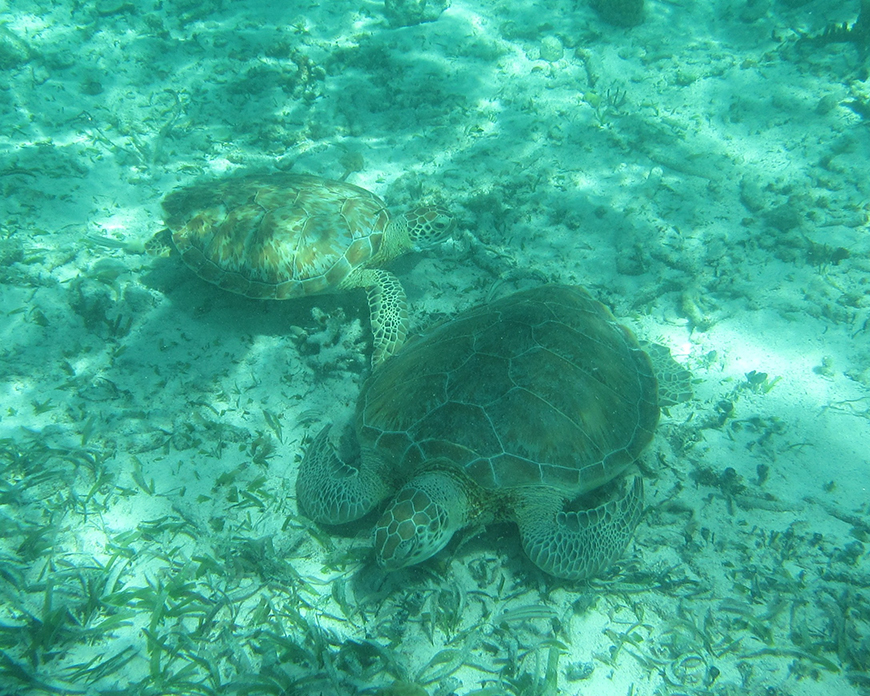
Today was such a fun day full of new experiences. We went snorkeling on the Belize Barrier Reef at two different locations. I cannot even describe how much fun this was. Shark Ray Alley was our first stop and I was so incredibly nervous because we would be in the water with sharks. Granted, they were nurse sharks, and not very large, but it was still super scary at first. Once we all got in the water, we followed our guide, Carlos, and he showed us lots of different animals in the water. We saw lots of different species of fish, rays, sharks, and coral.
I was so excited to be in the water doing this, and looking back, my brain is convinced it was not real. It was so crazy to be an arm's reach away from these animals that I had really only seen in the movies. There were so many spots where the coral almost came up to the surface, and I had to lie flat so I wouldn’t kick anything. It was scary but also exciting being this close. There are these beautiful creatures that in one instant I could destroy if I were not paying attention. It made me realize how valuable these organisms are.
Before heading to our second stop, we ate the most delicious egg salad sandwiches on the boat. This was the first time I had ever had egg salad, so I think that is part of the reason I liked it so much. We enjoyed our sandwiches before sailing to our next destination.
Our next snorkeling stop was Hol Chan, which was so much fun. The water and reef systems were deeper and larger, which was very exciting! We saw many different fish and coral, and even saw an Eagle Ray. Like the last location, it was so unreal to be this close to all the animals. It was fun to watch all of the organisms interact, and it made me realize how complex the world really is. This particular location was very exciting because there was an underwater cave – something I had only really seen in movies. Part of me felt like I was starring in a poorly filmed shark movie, or an episode of Outer Banks. It was crazy to get to experience this in real life. Carlos was the first to swim down and through it, before giving the rest of us a chance. I tried to dive down and swim through it, but I panicked because I thought I was going to run out of air. Part of me wishes I hadn't given up so easily, because that was a once-in-a-lifetime opportunity.
After we were finished snorkeling, we swam back to the boat and sailed back to the marine research station where we were staying. The boat ride was so nice, and I felt like I could sit there for the rest of my life. It was the most relaxing thing ever. We had a short lesson in the classroom at the center, before eating a really delicious dinner and winding down for the night. If the rest of this trip is anything like today, I am not sure I will be able to sleep tonight.
DAY THREE (March 13)
Drew Hanson, Environmental Science and Sustainability major
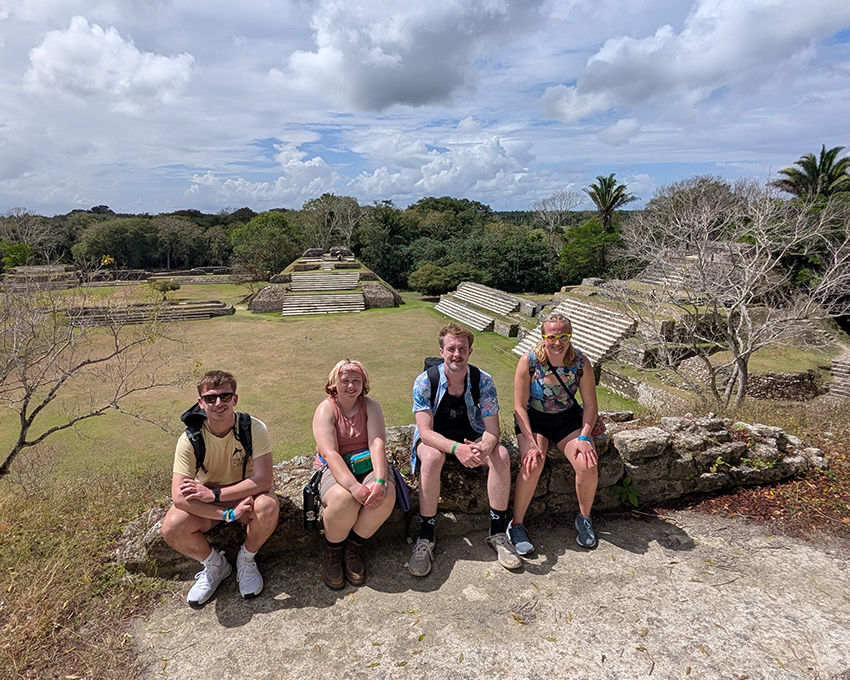
Today was all about new adventures. We woke up bright and early for some breakfast made by Maggie, the amazing cook at TREC. We finished our food and met as a group at the pool in the TREC. As a whole, we walked down the road to our boat launch. We were greeted by Dr. Ken, his wife Maureen, and our captain, Renard. Renard took us across the bay, pointing at all of the birds and telling us their names. This boat ride was about an hour long, and we just took in the Caribbean Sea, which was beautiful.
Our adventure today was on the mainland. To get there, we had to steer up the Belize River, a beautiful river with manatees, crocodiles, and different species of fish. We eventually went ashore at a spot called the Manatee Landing, where we met our driver. The driver took us up the Northern highway, where we viewed all of the beautiful sights around.
But we weren’t just going to see the mainland. Instead, our main goal was to learn about the Ancient Mayan Civilization. Upon arriving at the archaeological site “Altun Ha”, we were greeted by our guide, Charles. Charles was very enthusiastic about the Maya, so we knew we were in for a good one. Charles was full of information, listing all of the trees around us and how some were apple trees or maybe even a cinnamon tree. These trees were here for the civilians who needed any form of treatment. It was their medicine. With a population of roughly 30,000 people, this Mayan civilization was in need of trees, whether they used them for medicine or for housing. While there was a population of 30,000, only about 10,000 lived at the site we visited, while the other 20,000 lived in the outskirts, surrounded by trees. This site was broken into two different plazas: “Plaza A” and “Plaza B”. Each plaza held huge temples, some containing thrones, others containing prison cells, and one holding an altar. This civilization in particular was very big on sacrifices and followed a strict belief of the “nine levels”; these are the nine levels of health and/or heaven – or the nine stages of punishment in the underworld.
We also learned that the most important things to the Maya were jade and animal clothing, with animals such as jaguars, tigers, and leopards, viewed as the strongest animals in the jungle. Some of the rituals we learned about included bloodletting, which is when civilians would pierce their tongues, and in many cases, also pierce their genitals. We finished all of the walking up and down the monuments. When we all regained our breath, the rain started falling. We then went up to our final temple, the “Altar Temple,” where we had a great view from the top.
After our climb, we went down to the archaeological museum, after which we checked out some of the community markets and saw some amazing handcrafted items.
To finish the day, we backtracked our paths and drove from the Mayan Grounds to a local restaurant and had some amazing chicken and rice, with potato salad, and we saw a crocodile in the pond out back. After dinner, we headed back to the boat at Manatee Landing, which is where we departed and headed through the Belize River, including a shortcut through some mangrove trees. On our boat ride back to San Pedro, we saw a pod of dolphins, and we all, of course, had to take videos and pictures as tourists do. We left the dolphins' area and headed back to our dock to wrap up our day. It was an amazing adventure. I learned so much and took a lot of good pictures!
DAY FOUR (March 14)
By Isaac Shively, sophomore Environmental and Watershed Science and Biology major, Coaching and Sports Management minor
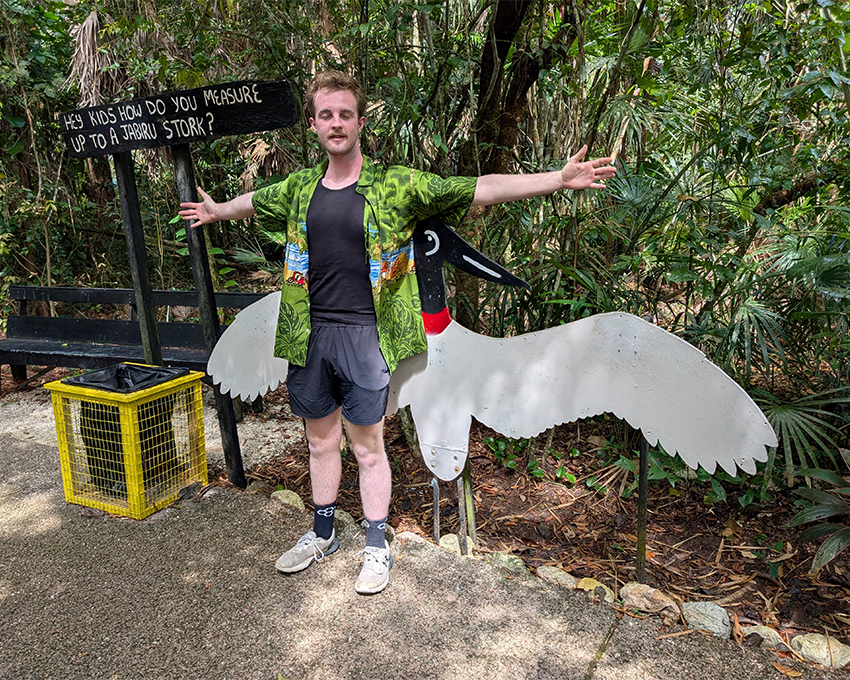
Today, we set our courses for the mainland of Belize again. We had the earliest morning yet as breakfast was at 5:45 AM. Breakfast was crafted by the wonderful Ms. Maggie, consisting of French toast and fresh fruit such as pineapple, watermelon, cantaloupe, and papaya. We then walked to the beach to meet our guide, Renard.
Renard took us on a boat ride through the back reef of Belize in the Caribbean Sea. We docked at Manatee Lookout, which is around 7 miles north of Belize City. To reach Manatee Lookout, we took a shortcut through a mangrove forest, which led us to the Belize River, home to many species, including manatees and crocodiles. We then took a van south toward the Maya Mountains.
After 3 hours in transit, we arrived at the Belize Zoo. The zoo is absolutely gorgeous, nestled in the jungle – the natural habitat of all the animals that are housed in the zoo. All of the animals at the zoo were born in Belize. Another fact: the animals are all rescues who have been rehomed at the zoo since they are unable to live in the wild. Right when we walked through the gates, we saw the tapir, which is Belize’s national animal. The zoo also houses reptiles, mammals, amphibians, and avian species. My favorite animals were the spectacled owl and the grey fox. I started to record a video of the spectacled owl, and it flew right at me and landed on the branch in front of me, and posed for the picture! The grey fox looked similar to a fox we see at home, but was really small and was missing a rear leg, which is the reason it was unable to survive in the wild. It was an amazing experience seeing monkeys in their natural trees and a puma hiding while it rested in the thick undergrowth. The zoo as a whole was extremely wholesome.
From the zoo, we headed further south to Nohoch Ch’een, which translates to Big Cave. We enjoyed a lunch of rice and beans with chicken, a side salad and an orange glass bottle Fanta. The history of the cave is long; it formed over thousands and thousands of years. It is a dissolution cave, which means it formed from slightly acidic groundwater slowly flowing through the mountain, dissolving the calcite in the limestone. The whole mountain was formed from limestone, which consists of ancient shells and fossils that created the sedimentary rock. The cave system was pitch black; our only light was from flashlights. There were insect bats near the entrances of the cave, which eat on average 600 mosquitoes an hour. Incredible! Our guide's name was Nelson, a local whose first time in the cave was when he was 8 years old and who has loved it ever since. The Mayan culture viewed these caves as portals to the underworld and would perform rituals for the gods for favorable outcomes.
We made the journey back to our base camp at TREC. Along the trip, we met many new people – all with smiling faces. Ms. Maggie was waiting with a wonderful dinner feast!
DAY FIVE (March 15)
By Cecilia Groth, junior Environmental and Watershed Science and English Writing major
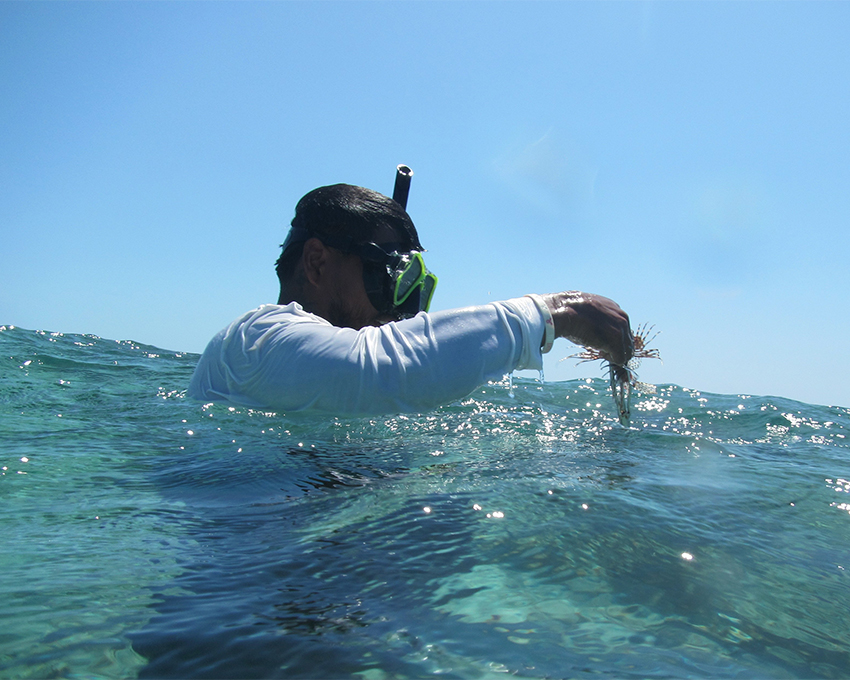
Today we went back to snorkelling! We boarded the ship, the Goliath, at 9 in the morning, and our first stop was only 15 minutes away: Pillar Coral. It has a distinct “halo,” where two patches of coral are surrounded by a ring of sand before the grass begins again. Most of the coral is just the skeletal frameworks, as rising water temperature has killed it. The fish still inhabit the area as long as the framework stands, however! There were tons of fish, most of which we had seen before. Seeing them the second time is still as awe-striking as the first.
At Pillar Coral, we saw a few lionfish. As they are invasive, our guides killed them with a speargun. Most guides here carry spearguns, as lionfish are considered “kill on sight” fish. They’re very distinctive, with bright red or black stripes on top of white and lots of prongs that can sting. I wasn’t stung, but they reportedly hurt a lot.
After a quick lunch of amazing chicken salad sandwiches, we headed to our second location: Tres Cocos. It was named after three coconut trees on the shore. The coral stands there were a bit more cohesive, connected in a loose wave. It wasn’t too far away from Pillar Coral, so we saw mostly the same fish. However, under an overhanging piece of coral, we spotted a porcupine pufferfish! It wasn’t puffed, unfortunately, but it was cool nevertheless. It hid very well, as the shadow from the coral blended well. I almost didn’t see it at first.
At both Pillar Coral and Tres Cocos, the current was incredibly strong. Every wave pushed me back. It was a struggle to keep from bumping into the coral (and the sea urchins hiding in said coral!). What was most interesting to me was how the waves worked: at the reef crest (the line between the reef and the ocean), there is a line of traditional white waves. Once they hit the reef, the coral breaks up the waves’ energy. This makes the calmest part of the reef right along that edge, as the waves have to pick up all the energy they lost. That’s why after the reef crest, the waves are the strongest at the shore: that’s the farthest from the crest, and where they have the most time to pick up energy.
Overall, I greatly enjoyed snorkelling again and can’t wait for tomorrow!
March 15, 2026