The implications of white supremacy
Although the racially charged protests and anti-protests in Charlottesville, Va., in August are fresh in our minds, issues of white supremacy have endured for centuries.
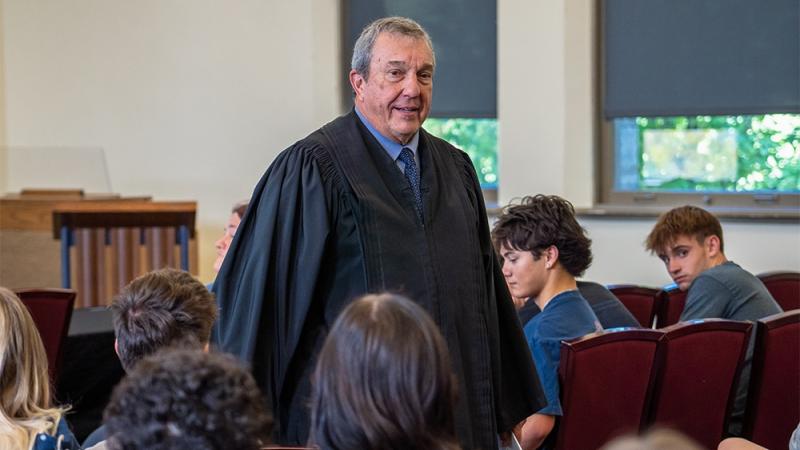
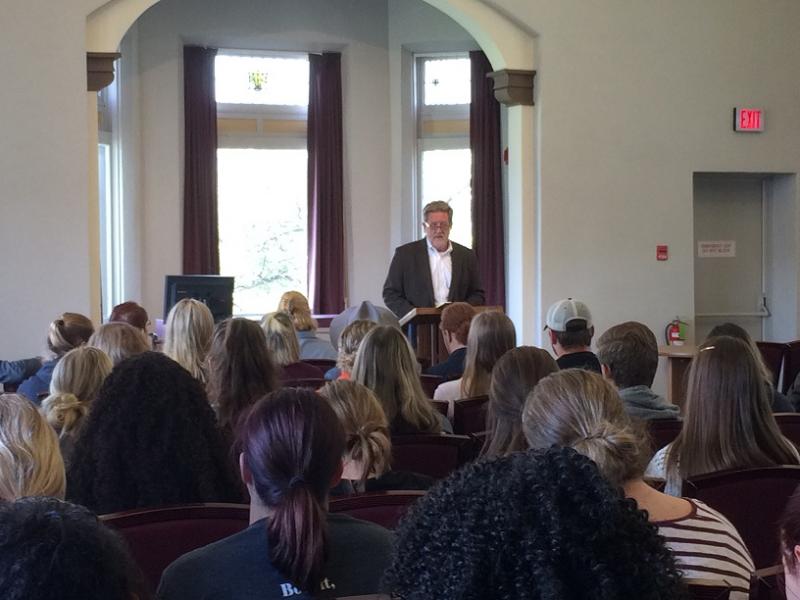
History professor Dr. David Hogan enlightened a packed Herbster Chapel Thursday with a historical lesson about “The Misuse of History: White Supremacy in the U.S.” He began by offering definitions for “white supremacy” and “white.”
“Originally, white supremacists, or WASPS, ruled. Everyone else was below them. Then, waves of immigrants were gradually absorbed into ‘whitedom,’ and through longevity, they worked their way up in politics and society,” Hogan explained.
Although it’s generally thought that white supremacists are based in the South, that’s an inaccurate assessment. “Actually, white supremacy exists everywhere. Racism exists everywhere,” he said.
Hogan walked students, faculty and staff through the rise of white supremacy, beginning with the end of the Civil War, a time in our history when some 4.5 million slaves were freed.
He discussed the implications of the plight of the freed slaves, the role of the Ku Klux Klan, the presidencies of Rutherford B. Hayes and Ulysses Grant and the onset of the Jim Crow laws, which, through segregation, “put African Americans in a permanent second-class status.”
“We have had some improvements since the ‘60s with Affirmative Action and desegregation, but we’re still working on it,” Hogan said. “We do still have major problems with racism and white supremacy. We have embedded inequalities. We have a disproportionate level of poverty among African Americans.”
For many historians, Hogan included, the issue today centers on the ways in which white supremacists are misusing the study of history to rally support for their positions. The most current flashpoint: removal of Confederate statues from public places.
“Many believe this is a sign of disrespect … an insult to their heritage, their ancestry,” he said. “I’d say that most of those who are responding to this flashpoint are not worried about family history.
“What’s going on here is that people are trying to preserve the old order when white people were in charge and black people were defined by law as inferior.”
Hogan said he is troubled by those who hold up symbols of racism, white supremacy, xenophobia and hatred – even genocide. “That has become so mainstream, and it’s terrifying.”
In summary, he said racism and white supremacy are not new in this country, but their dangerous insurgence should make us all pause and think about the human condition that created and perpetuates them.
September 8, 2017