Constitution Day conversation challenges Heidelberg students to find their voice
“Sitting on the sidelines changes absolutely nothing.”
That was one of the clearest messages Ohio State Rep. Allison Russo delivered Thursday to Heidelberg University students and community members gathered for Constitution Day.

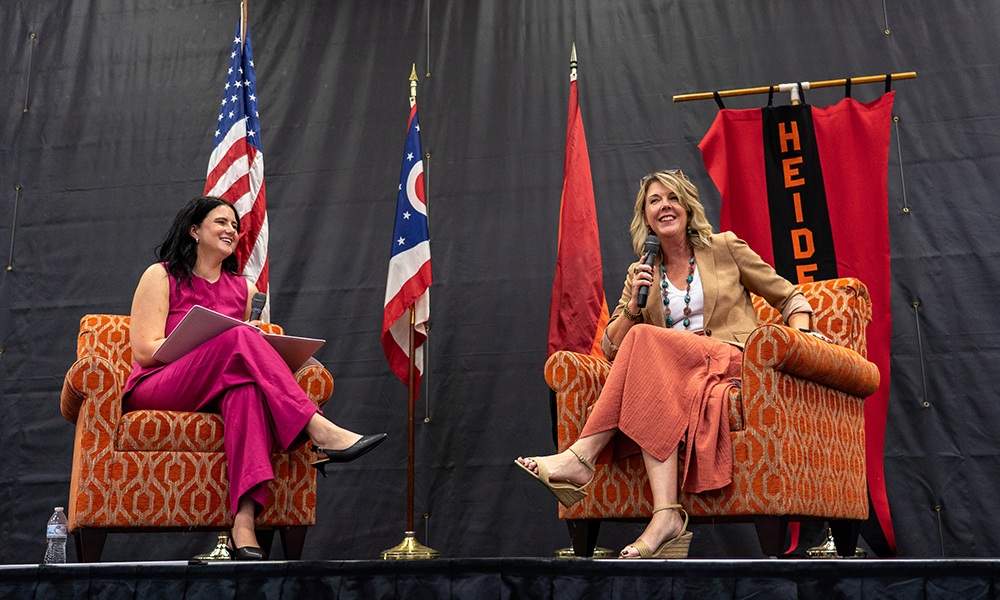
Russo, who represents Ohio House District 7, joined Heidelberg Student Senate President Shannon Petrulis for “A Conversation on the Constitution,” a Q&A that explored the meaning of the U.S. Constitution, the power of Ohio voters and the role young people play in shaping democracy.
With a November general election approaching, the conversation also tackled timely issues facing Ohio voters, including voting rights, voter identification requirements and State Issue 3, a proposed constitutional amendment that will appear on the Nov. 3 ballot.
The Constitution Day event also provided an opportunity to register to vote and copies of the U.S. Constitution for students.
What does the Constitution mean today?

Russo began by offering three different ways people commonly interpret the U.S. Constitution: textualism, which focuses on the language of the document; originalism, which considers the text along with the intentions and historical context surrounding its creation; and the concept of the Constitution as a living document, an approach Russo said she follows.
“It is fundamental in the rights it defines for us as Americans, but we have to put it into the context of the modern era,” Russo said. “Some of the issues we are confronting today our founding fathers would not have considered. How we look at our rights has evolved over time.”
That evolution, she said, is particularly relevant to college students, who are coming of age at a time when long-established laws and interpretations are being challenged in courts.
“The laws that have been taken for granted are being tested,” Russo said, pointing to contemporary debates surrounding issues including free speech.
For students, she said, understanding those debates means recognizing that the Constitution is not simply a historical document to be studied in a classroom.
It is a framework that continues to shape their lives.
Ohio’s unique constitution
Russo turned her focus to Ohio’s constitution.
Like the federal government, most states have their own constitution, and Ohio's document contains provisions that establish rights and processes specific to the state. One of the most significant, Russo explained, is Ohioans' power of direct democracy.
The Ohio Constitution reserves to citizens the power to propose laws and constitutional amendments and to approve or reject certain laws through the ballot.
Russo described that authority as a powerful way for Ohio citizens to exercise influence beyond the actions of the state Legislature.
Under Ohio's constitutional framework, citizens can initiate a constitutional amendment through petition, propose laws through an initiative process and use the referendum process to seek voter approval or rejection of certain legislation passed by the General Assembly.
“That’s why it’s so important to vote,” Russo said.
The message resonated with the larger theme of the Constitution Day program: Democracy is not something that happens somewhere else, to someone else.
Citizens are part of the process.
A timely look at Issue 3
That principle took on particular relevance as the conversation turned to State Issue 3, a proposed constitutional amendment concerning voter identification.
The Ohio Secretary of State's office says Issue 3 would require voters to present photo identification when voting and will appear on the Nov. 3, 2026, general election ballot.
Russo shared her opposition to the proposed amendment, explaining that her concern centers on the photo identification requirements contained in the measure and what she views as potential challenges posed by the forms of identification – many of which stand to be outdated – that would be required.
Russo described herself as a strong supporter of voting and voter participation, emphasizing what she sees as the consequences when citizens do not take part in the process.
‘Every political decision … impacts your future’
Perhaps the strongest part of Russo’s message came when spoke directly to the students.
“Every political decision in the state Legislature and in Congress impacts your future,” she told them.
Those decisions, she explained, can affect higher education funding, housing, economic opportunities, health care, the environment and even rules governing sports.
“Every single issue impacts your future more than it impacts my future,” Russo said.
Yet, she noted, young voters traditionally participate at lower rates than older voters. As an illustration, she pointed to voter registration among Ohioans age 70 and older, which she said is about 80%.
“They are making decisions about your future,” she said
With statewide offices, congressional seats and other offices on the November ballot, Russo encouraged students to make sure they are registered and prepared to participate. Ohio's official 2026 election calendar lists Oct. 5 as the voter-registration deadline, with early in-person and absentee voting beginning Oct. 6.
But voting, she emphasized, is only one way young people can become engaged.
“People your age in college don’t necessarily think about political science … but you need to understand the importance of your involvement in government,” Russo said.
Beyond the ballot
So what does civic involvement look like for a college student?
Russo offered a simple starting point: Pay attention.
Know what is happening in your community. Follow the work of local and state lawmakers. Introduce yourself to elected officials, she said, noting that state legislators are often more accessible than students might expect. Reach out to members of Congress.
And for students who want to become more deeply involved, she suggested volunteering on a campaign or pursuing an internship with one.
What comes next for this generation?
Petrulis closed the conversation by asking a question that brought the discussion back to the students themselves:
What issues will their generation have to confront?
Russo pointed first to voting itself.
“The very right to vote,” she said, predicting that challenges involving election laws will continue.
She also pointed to free speech, particularly as technology and artificial intelligence continue to reshape how information is created and shared.
The issues may change. The technology may change. The political landscape may change.But the responsibility of citizens remains.
“Sitting on the sidelines changes absolutely nothing,” Russo said.
For Heidelberg students, Constitution Day offered more than a look back at a document written more than two centuries ago. It was an invitation to understand how that document continues to shape the rights, responsibilities and choices facing their generation — and to recognize that democracy depends not simply on what government does, but on what citizens choose to do.
At Heidelberg, that conversation starts with knowing your rights, understanding your role and finding your voice.
September 17, 2026