A connection, a calling: How senior Olivia Raubenolt found her path to geriatric medicine
Sometimes, the most meaningful moments in health care don’t require a prescription, a procedure, or even a word. Sometimes, all it takes is a piano, a familiar song, and a willingness to meet someone where they are.
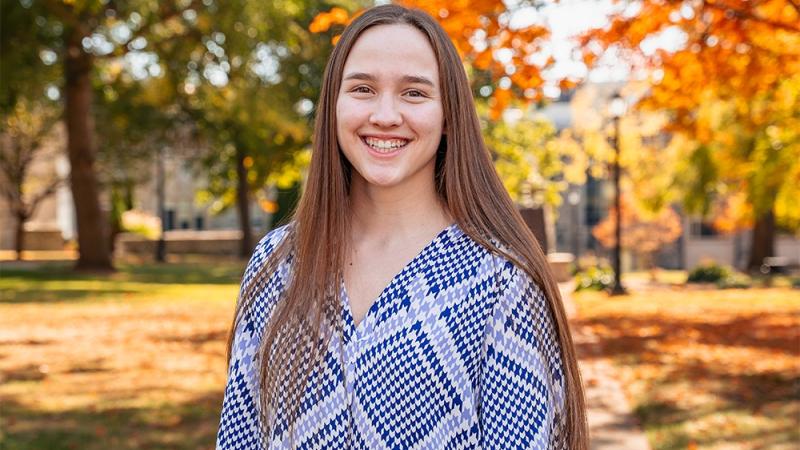
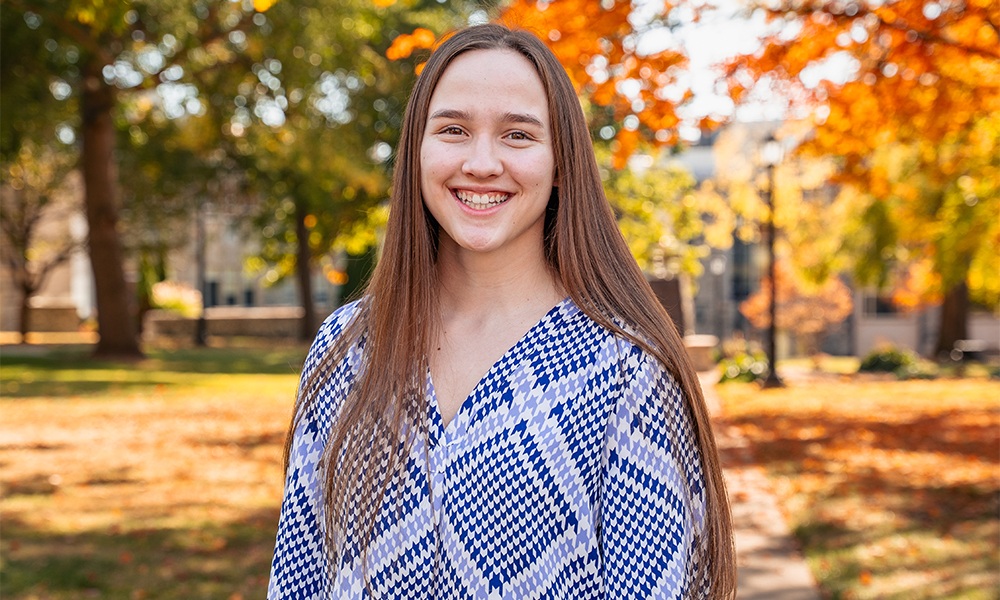
For Olivia Raubenolt, a senior biology major at Heidelberg University, that lesson came to life at Elmwood Assisted Living at the Shawhan in Tiffin, where she interned with residents living with Alzheimer’s disease and other forms of dementia.
What began as an opportunity to gain hands-on experience in health care became something much more meaningful, sparking her passion for caring for older adults and developing a deeper interest in the complexities of the brain.
Through her interactions with residents, Olivia came to understand that meaningful care extends beyond treating a medical condition. It involves recognizing the person behind the diagnosis and understanding that even the smallest acts of kindness can make a difference.
“You may never know the impact you've had on someone else's life, but there's something incredibly meaningful about knowing you made a difference, even if you never receive anything in return,” Olivia said.
It's a lesson Olivia will carry with her as she prepares for medical school and a future in neurology.
Unexpected path to a passion
Although Olivia had long envisioned a future in medicine, working with older adults was not originally part of that plan. Since middle school, she had set her sights on becoming a cardiac surgeon. But when she began searching for an internship that would provide hands-on patient care experience, she discovered a path she hadn't considered.
She learned Elmwood was looking for care managers to work with its senior residents.
On her first day, Olivia discovered she would be working on the Memory Care floor. With no prior experience, she wasn’t sure what to expect but was encouraged to give it a chance.
“I didn’t know what memory care meant at first,” she said. “But when I went to the floor, I was very quickly able to see the wide range of patients from early-onset (Alzheimer’s/dementia) to end-of-life care.”
Her reaction surprised even her.
“I fell in love with it. I’m so glad they started me there.”
The experience changed the trajectory of her career. While she had always been drawn to medicine, her time at Elmwood helped her discover a specialty that combines her interest in science with something equally important to her: building relationships with patients.
“There aren’t a lot of people who want to work with older people. They’re so undervalued,” Olivia said. “But I think I just kind of have that personality.”
Her work has taught her that patient care requires more than medical knowledge. It calls for patience, flexibility, empathy, and the ability to communicate in different ways.
Some residents are not verbal, Olivia explained. In those moments, a reassuring presence or simply holding someone’s hand can communicate more than words.
“Sometimes saying nothing is the best form of communication,” she said.
Having played piano since second grade, Olivia never imagined that her love for music would become another way to connect with residents. One resident in particular especially enjoyed listening to her play. When Olivia discovered the resident loved the Beatles' “Let It Be,” she taught herself the song.
When she played it for the resident, the woman began dancing, overcome with happiness.
“She most likely won’t remember me or that I learned that song for her, but she will remember how it made her feel,” Olivia said.
That moment reinforced something Olivia had come to understand about caring for people with Alzheimer's disease: Even when memories fade, meaningful connections remain possible.
She has also developed relationships with residents and their families, learning their stories and discovering the many ways people living with dementia continue to connect with those around them.
Those experiences have helped Olivia see beyond a diagnosis and recognize the individual behind it. Her internship, she said, has helped her grow as a person and taught her to adapt to the needs of others – skills she will take into her medical career.
Walking for the people behind the disease
Olivia’s experiences at Elmwood also inspired her to take action beyond the facility.
When she learned about Tiffin’s Walk to End Alzheimer’s, she recognized an opportunity to support the residents, families, and caregivers who had become such an important part of her life. This year, she participated as both a walker and a fundraiser. She has already raised $500 and plans to continue fundraising.
For Olivia, the walk was about honoring the people she knows personally while standing alongside others whose lives have been changed by the disease.
And she’s not finished. As she prepares to attend Lake Erie College of Osteopathic Medicine in Erie, Pennsylvania, in the fall, she hopes to become involved in Erie’s larger Walk to End Alzheimer’s event.
The science behind the diagnosis
Olivia’s interest in Alzheimer’s has extended into the classroom, too.
For her senior biology seminar, she chose to investigate the disease through a research project titled “Preserving Connections, Protecting Memories: Understanding Alzheimer’s Disease.”
Her research explores how the loss of synapses – the connections between nerve cells that allow them to communicate – contributes to memory impairment in people with Alzheimer’s.
She is particularly interested in microglia, the brain’s immune cells, and how they may contribute to the excessive removal of synapses. As these connections are lost, communication within the brain becomes disrupted, contributing to cognitive decline.
By better understanding the mechanisms behind synapse loss, researchers hope to identify ways to protect these vital connections and ultimately preserve memory.
Through her research, Olivia is learning another way to approach a disease she has come to know. Her experience at Elmwood has shown her the personal impact of Alzheimer’s, while her academic work is helping her understand the science behind it.
She finds hope in the progress being made.
Prepared for what’s next
In her last semester at Heidelberg, Olivia is feeling both excited and anxious about what lies ahead. She credits Heidelberg’s hands-on learning opportunities and close relationships with faculty for helping her prepare.
Currently enrolled in Heidelberg’s cadaver prosection class, she is gaining experience she believes will give her an advantage as she begins medical training.
Her anatomy and physiology coursework and laboratory experiences have helped Olivia and her peers build a strong foundation and gain a leg up as they enter graduate school. Just as valuable, she said, are the connections she has developed with professors who provide academic guidance and personal support.
Looking ahead, Olivia is most excited about clinical rotations and the opportunity to work directly with patients.
Her experience at Elmwood has already given her a glimpse of the relationships she hopes to build throughout her career and sparked her interest in neurology..
Seeing the person, not the diagnosis
AAs Olivia looks toward a future in medicine, she hopes people will approach Alzheimer’s disease with greater understanding and compassion.
People living with dementia may need help with tasks others take for granted, she said, but that doesn’t make them fundamentally different.
“They’re human just like us. They just may need extra compassion and assistance with the things that you and I find easy. It just may look a little different for people with dementia,” she said.
It’s a perspective shaped not just by textbooks or research, but by everyday interactions: sitting beside a resident, learning a favorite song, holding a hand or sharing a moment of joy.
Her advice to fellow Heidelberg students who want to connect their academic interests or future careers with a community need is simple.
“Go do it. Find out what you’re passionate about and find a way to go make a difference now. You don’t have to wait to start doing what you love.”
And for families who entrust someone they love to her care, Olivia offers a message of gratitude.
“Thank you for trusting me to take care of someone who is so special to you. It’s an honor to be a part of their story and their family’s story,” she said. “I hope I made a difference to them but also brought comfort to them as well.”
For Olivia, that is what medicine is ultimately about: pairing scientific knowledge with compassion, recognizing the person behind the diagnosis and finding ways to make a difference – today.
October 29, 2026